A cheap input rate can hide a costly output-heavy agent. If you are researching GLM 5.3 price, start by identifying what you are buying: direct API tokens, a Coding Plan subscription, or credits from a separate service. Those are different billing products, even when the model name looks identical.
This article uses Z.ai's official price and plan documentation and GLM5's model catalog, reviewed November 13, 2026. The contribution is transparent bill arithmetic with labeled assumptions. The examples are not customer invoices or a claim of a private production test.
GLM 5.3 price: the direct API schedule
| Category | Direct Z.ai price per million tokens |
|---|---|
| Fresh input | $1.40 |
| Cached input | $0.26 |
| Output | $4.40 |
Read each category separately. Cached tokens replace the fresh-input category for the portion actually billed as a hit; they are not an extra charge to add to those same input tokens. Check current cache-write terms and tool prices before estimating a full workflow.
The formula behind a bill
For a simple text request, the token component is:
cost = (fresh_input * 1.40 + cached_input * 0.26 + output * 4.40) / 1,000,000
Add any separately billed tools, cache creation charges, or other applicable items. Use provider usage metadata to divide fresh and cached input. Guessing a cache hit rate from prompt similarity can produce an unrealistically low forecast.
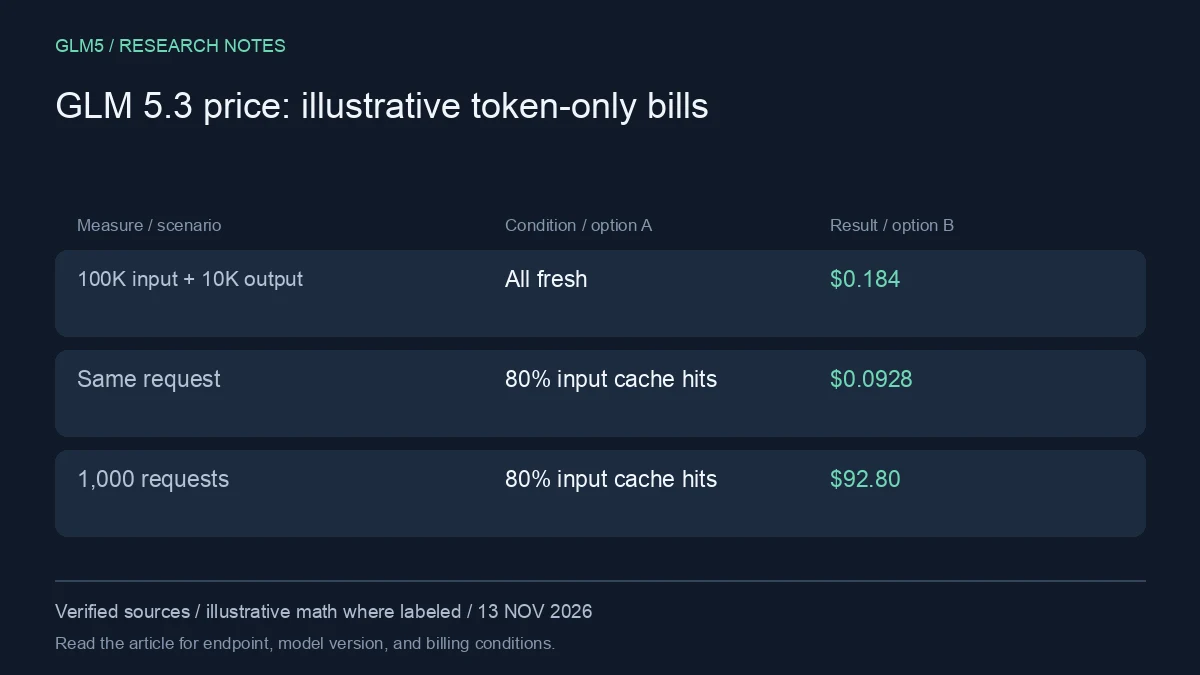
An illustrative 100,000-token input with 10,000 output tokens costs $0.184 if every input token is fresh. At an 80% billed cache-hit share, the same input is $0.0488 and output is $0.044, totaling $0.0928. Across 1,000 identical requests, those token-only totals are $184 and $92.80.
Output is often the decision variable
At the listed GLM 5.3 price, output costs more per token than fresh input. Asking an agent to repeatedly restate a full file can therefore be expensive. Request a patch or targeted explanation when that is what the downstream workflow actually needs. Validate that shorter output still satisfies the acceptance criteria.
For an agent loop, record every attempt. A failed answer with substantial generated output can still consume tokens. Do not estimate monthly spend by multiplying only the final successful response by the number of tasks. Include repair calls and repeated context as part of each completed job.
Direct dollars are not GLM5 credits
GLM5 is a separate service. Its API model page lists credit rates and states that API calls use the same GLM5 balance as Chat. The direct Z.ai GLM 5.3 price is useful for understanding the original provider's schedule; it is not an automatic quote for GLM5, another reseller, or a Coding Plan.
Check GLM5's current model rates before estimating a bill there. Use the billing guide for reservation and settlement rules, then compare available plans against the work you intend to perform.
The GLM 5.3 price you should optimize is the total for a useful, accepted result. A lower request bill that creates more repair work can be a false saving.
Build a forecast from a small sample
- Collect representative short, medium, and long requests.
- Record input, cache-hit, output, and tool usage separately.
- Keep retries attached to the original task.
- Calculate cost per accepted task for each task category.
- Multiply by expected volume and add a buffer based on observed variation.
Keep a separate scenario for unusually long requests. An average can hide the small number of agent runs responsible for most of the bill. A spending ceiling and a tested cancellation path are more reliable controls than assuming every future request will look like the median one.
When your estimate and bill disagree
If the bill is higher, inspect output volume, missed cache prefixes, tools, retries, and the model route actually selected. If a credit purchase looks expensive relative to direct API rates, compare the purchased product's own schedule rather than treating credits as raw tokens.
Do not solve every unexpected charge by shrinking the input indiscriminately. Removing required context can increase retries and total cost. Instead, remove duplicated material, keep stable prefixes where supported, and verify that the prompt still contains the evidence required for an accepted result.
FAQ
Is GLM 5.3 price the same as a Coding Plan fee?
No. The direct API meters token categories; the Coding Plan has periodic allowances and model multipliers. A monthly subscription is not unlimited general API capacity.
How much does caching save?
The input-category reduction from $1.40 to $0.26 is about 81.4%. The whole bill falls by less if output or tools make up a large share. Our worked example shows why an input discount should not be advertised as an equal discount on total spend.
What should I buy first?
Start with enough capacity for a representative evaluation, then choose based on accepted-task cost and your actual workflow. Open GLM5 Chat for a small task, or use the API quickstart for usage records you can analyze.
Sources
- Z.ai official API pricing
- GLM 5.3 model documentation
- GLM Coding Plan allowances and multipliers
- GLM5 API model IDs and credit rates
Source review: November 13, 2026. Prices and allowances are snapshots. Calculations in this article are illustrative, not measured production bills. GLM5 is the publisher of this article and a separate service from Z.ai.