A repository migration is not complete when an assistant says it is done. It is complete when the patch passes the checks and a reviewer accepts it. GLM 5.3 vs Opus 5 should be evaluated against that finish line, especially when one candidate has a higher output-token rate.
This article uses official Z.ai documentation and Anthropic's published Opus price comparison, reviewed November 13, 2026. It provides a production coding scorecard rather than an invented SWE-bench result. We have not independently measured a head-to-head win rate.
GLM 5.3 vs Opus 5: control the model generation
Claude Opus 5, Opus 5.5, and Opus 4.8 are different targets. Z.ai's GLM 5.3 launch card includes Opus 4.8, not a universal result for the entire Opus family. If your integration silently upgrades a moving alias, record that fact and rerun your regression set.
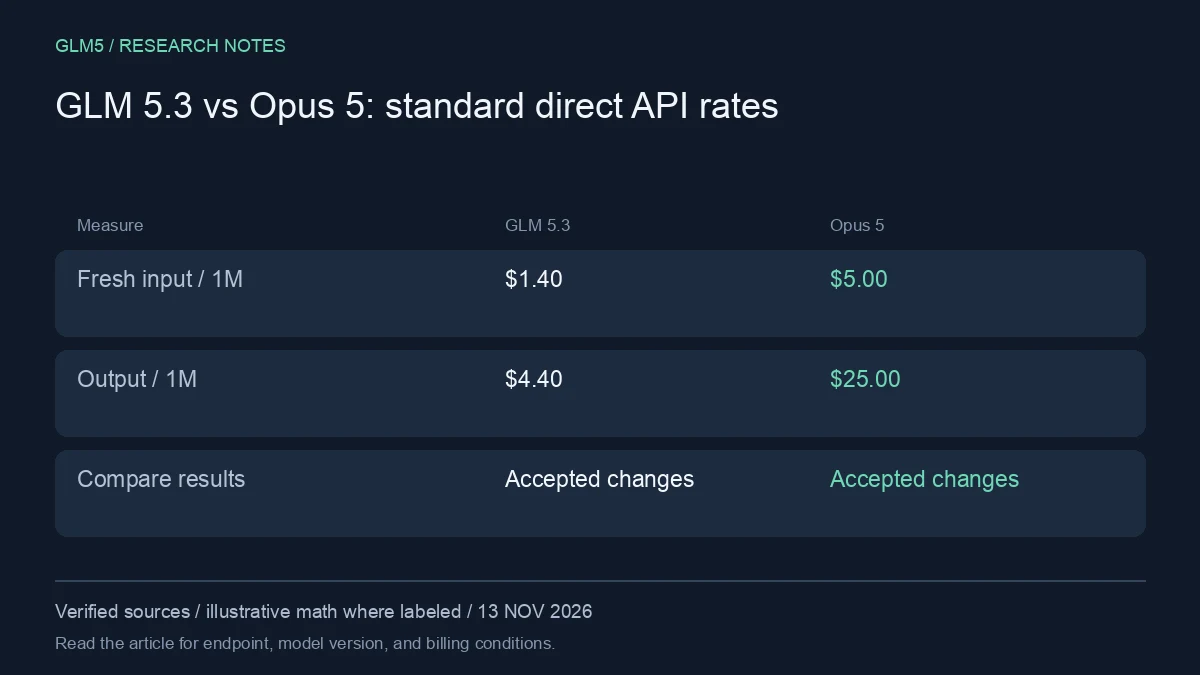
Anthropic's Opus 5.5 announcement lists Opus 5 standard rates alongside the newer model. For the historical Opus 5 comparison, those listed rates are $5 per million fresh input tokens and $25 per million output tokens. Z.ai lists $1.40 and $4.40 for GLM 5.3. Confirm availability and current account terms before starting a paid experiment.
Use a patch acceptance contract
Choose a bug where you can write a failing reproduction before the model starts. Specify allowed files, the expected behavior, compatibility constraints, and the commands that prove success. Give both candidates the same contract. Review whether they solve the requested issue without silently changing unrelated behavior.
For GLM 5.3 vs Opus 5, add a migration task with a backward-compatibility requirement. A large patch can pass new tests while breaking old callers. Keep the original regression suite and require an explanation of interface changes. Count unnecessary edits as review burden, not productivity.
A worked economic threshold
Assume each attempt consumes 100,000 fresh input tokens and 10,000 output tokens. At the published standard rates, that is $0.184 for GLM 5.3 and $0.750 for Opus 5. This is a controlled example, not an observed coding bill. Different output lengths, caching, and tool charges change the comparison.
Suppose the cheaper candidate needs several attempts. Add those attempts and the review minutes rather than comparing only the first request. If the more expensive candidate consistently removes hours of manual correction, the token premium may be justified. The relevant denominator is an accepted change.
Protect the codebase during the trial
Run agents in disposable branches or isolated workspaces. Keep production credentials out of the test environment and require review before applying generated database or deployment commands. These controls should be identical across candidates so the test measures model usefulness rather than accidental access differences.
A GLM 5.3 vs Opus 5 decision can also be staged: use one model for routine edits and reserve the other for a defined failure class. Validate the handoff with actual failing tests and explicit requirements so escalation does not become a fresh, uninformed attempt.
Run a comparison that survives contact with your codebase
Begin with three representative jobs: a narrow bug with a failing test, a change spanning several files, and an investigation where the correct result is an explanation rather than a patch. Write acceptance criteria before either model sees the task. Keep a clean checkout for each run so a previous answer cannot leak into the next attempt.
Hold the agent wrapper constant where both models support it: system instructions, repository access, test commands, timeout, and tool permissions. Record any unavoidable difference. A model with search access should not be compared with one denied the source material needed to solve the problem. Save exact model IDs, dates, effort settings, provider routes, and token usage.
| Measure | What to record | Why it changes the purchase decision |
|---|---|---|
| Correctness | Passing acceptance tests and manual review | A plausible patch can still be wrong |
| Completion | Finished result before the deadline | A partial answer creates more work |
| Cost | Every attempt, tool fee, and repair call | First-call price hides retries |
| Latency | First useful output and total completion | Fast streaming can conceal a slow task |
| Review effort | Minutes spent finding and fixing defects | Human time can dominate token spend |
Run each task more than once if your budget permits. Small samples are a screening exercise, not a statistically established ranking. Keep failed runs in the results. If a tool call breaks because of a wrapper mismatch, classify that failure separately from a reasoning error, fix the integration, and rerun both candidates under equivalent conditions.
You can try a representative prompt in GLM5 Chat, then use the API documentation for a repeatable integration. Only compare models actually listed by your chosen endpoint; a provider may expose an alias rather than the exact historical checkpoint named in a chart.
Troubleshooting an unexpected result
A model that stops early may have hit an output ceiling, timeout, or tool error. Inspect the finish reason and logs before concluding that it cannot solve the task. For an irrelevant answer, first check whether the important files reached the model. For a surprisingly expensive run, examine repeated history, uncached prefixes, reasoning output, and repair attempts.
Do not increase context size as the first fix for every failure. Supply the files and test output needed for the next decision, preserve a concise task state, and set a spending limit. A long agent loop needs a stopping condition as much as it needs a capable model.
FAQ
Is there a universal winner?
No. Glm 5.3 vs opus 5 depends on input types, the exact served version, and the work you need accepted. Use the decision criteria above rather than treating a single public score as a guarantee.
Can I test without moving my whole application?
Yes. Keep your existing route and run a small evaluation through a separate configuration. Check the endpoint's model catalog first, impose a budget, and keep the original traces for review.
What should I do after the trial?
Choose the route that passes your quality threshold at an acceptable total cost. Review GLM5's model catalog and pricing options before committing a larger workload.
Sources
- GLM 5.3 model documentation
- Z.ai official API pricing
- Anthropic Opus 5.5 release and Opus 5 price comparison
- GLM5 API model IDs and credit rates
Source review: November 13, 2026. Prices and allowances are snapshots. Calculations in this article are illustrative, not measured production bills. GLM5 is the publisher of this article and a separate service from Z.ai.