An agent can emit tokens quickly and still finish your task slowly. GLM 5.3 vs DeepSeek V4.1 Flash is most useful when you distinguish first-token latency, sustained throughput, and time to a correct result. This article gives you a way to measure all three without presenting invented speed tests.
The comparison is based on Z.ai documentation and DeepSeek's official release and changelog, checked November 13, 2026. These are vendor disclosures, not our independent measurements. The key additional insight is model-version hygiene: the name in an old benchmark may no longer identify the model served by an API alias.
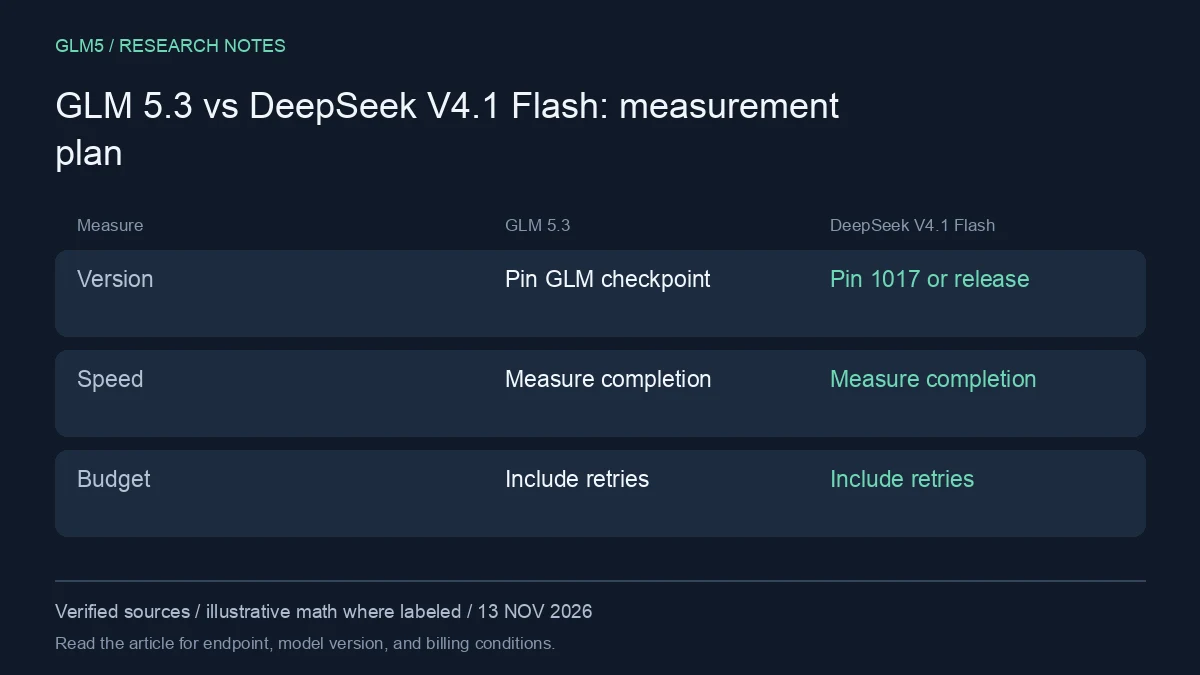
GLM 5.3 vs DeepSeek V4.1 Flash: pin the version first
DeepSeek introduced V4.1 Flash in September and subsequently published the V4.1-Flash-1017 update. Its changelog says the deepseek-flash API name accesses the updated model. The historical release page and later changelog also contain changed guidance about older model routing, so consult the later dated notice when they differ.
A benchmark from the initial release cannot automatically describe the October checkpoint. Likewise, GLM5's deepseek-v4-flash name should not be assumed to expose exactly the same routing as DeepSeek's direct endpoint. Confirm the selected provider and returned metadata.
Architecture is a clue, not a throughput measurement
DeepSeek's release describes an asymmetric encoder-decoder MoE with different active-parameter counts for input and output processing. GLM 5.3 is documented as a text reasoning model. These disclosures explain design choices, but neither parameter count nor a vendor efficiency claim tells you the tokens per second you will receive on a shared endpoint.
For GLM 5.3 vs DeepSeek V4.1 Flash, request shape matters: long prefill, short generation, cache hits, tool calls, and concurrency stress different parts of the serving stack. Avoid presenting one speed figure without its prompt length, output length, concurrency, region, and measurement date.
A useful throughput experiment
Prepare three request shapes: a short question, a long document with a short answer, and a coding task with a long response. Run an initial warm-up, then keep successful and failed observations. Measure end-to-end completion separately from first useful output. Add controlled concurrency only within your account's documented rate limits.
Report median and tail latency if you have enough runs, together with sample count and error rate. Do not drop timeouts to make an endpoint look fast. A high-throughput configuration that returns incomplete responses is not a production improvement.
Price each completed task
Use the exact direct or reseller schedule for the tested endpoint, including peak/off-peak terms where applicable. GLM 5.3 vs DeepSeek V4.1 Flash economics depend on generated tokens and retries as well as nominal rates. Keep a failed-run ledger so a second or third attempt is charged to the same task.
Prefer the route that meets your quality threshold within the deadline and budget. Use a separate fallback for rejected or stalled requests, and verify that switching routes preserves tool results and the latest conversation state.
Run a comparison that survives contact with your codebase
Begin with three representative jobs: a narrow bug with a failing test, a change spanning several files, and an investigation where the correct result is an explanation rather than a patch. Write acceptance criteria before either model sees the task. Keep a clean checkout for each run so a previous answer cannot leak into the next attempt.
Hold the agent wrapper constant where both models support it: system instructions, repository access, test commands, timeout, and tool permissions. Record any unavoidable difference. A model with search access should not be compared with one denied the source material needed to solve the problem. Save exact model IDs, dates, effort settings, provider routes, and token usage.
| Measure | What to record | Why it changes the purchase decision |
|---|---|---|
| Correctness | Passing acceptance tests and manual review | A plausible patch can still be wrong |
| Completion | Finished result before the deadline | A partial answer creates more work |
| Cost | Every attempt, tool fee, and repair call | First-call price hides retries |
| Latency | First useful output and total completion | Fast streaming can conceal a slow task |
| Review effort | Minutes spent finding and fixing defects | Human time can dominate token spend |
Run each task more than once if your budget permits. Small samples are a screening exercise, not a statistically established ranking. Keep failed runs in the results. If a tool call breaks because of a wrapper mismatch, classify that failure separately from a reasoning error, fix the integration, and rerun both candidates under equivalent conditions.
You can try a representative prompt in GLM5 Chat, then use the API documentation for a repeatable integration. Only compare models actually listed by your chosen endpoint; a provider may expose an alias rather than the exact historical checkpoint named in a chart.
Troubleshooting an unexpected result
A model that stops early may have hit an output ceiling, timeout, or tool error. Inspect the finish reason and logs before concluding that it cannot solve the task. For an irrelevant answer, first check whether the important files reached the model. For a surprisingly expensive run, examine repeated history, uncached prefixes, reasoning output, and repair attempts.
Do not increase context size as the first fix for every failure. Supply the files and test output needed for the next decision, preserve a concise task state, and set a spending limit. A long agent loop needs a stopping condition as much as it needs a capable model.
FAQ
Is there a universal winner?
No. Glm 5.3 vs deepseek v4.1 flash depends on input types, the exact served version, and the work you need accepted. Use the decision criteria above rather than treating a single public score as a guarantee.
Can I test without moving my whole application?
Yes. Keep your existing route and run a small evaluation through a separate configuration. Check the endpoint's model catalog first, impose a budget, and keep the original traces for review.
What should I do after the trial?
Choose the route that passes your quality threshold at an acceptable total cost. Review GLM5's model catalog and pricing options before committing a larger workload.
Sources
- GLM 5.3 model documentation
- DeepSeek V4.1 Flash release
- DeepSeek changelog and model routing updates
- GLM5 API model IDs and credit rates
Source review: November 13, 2026. Prices and allowances are snapshots. Calculations in this article are illustrative, not measured production bills. GLM5 is the publisher of this article and a separate service from Z.ai.