In mid-August 2026, the Chinese open-weight ecosystem experienced its most consequential 24 hours to date. On August 13, DeepSeek unveiled DeepSeek-V4-Pro-0813, a massive 1.6-trillion-parameter reasoning flagship designed to dominate mathematical logic and long-context processing. Less than 24 hours later, on August 14, Zhipu AI (Z.AI) launched GLM 5.3, taking the opposite architectural gamble: keeping their established base model intact while scaling post-training reinforcement learning to produce a dedicated coding and agentic powerhouse.
If you are an engineering lead or developer architecting production systems, this release pairing introduces a genuine dilemma. Both models feature million-token context windows, permissive open-weights licenses, and elite reasoning capabilities. Yet marketing headlines focusing purely on raw parameter size—1.6T versus 753B—obscure the operational realities of active weights, reasoning token latency, multimodal capabilities, and prompt-caching unit economics.
This comprehensive guide delivers a side-by-side engineering breakdown of GLM 5.3 vs DeepSeek V4 Pro. We evaluate verified benchmark deltas, dissect the underlying MoE mechanics, calculate realistic API billing scenarios, and outline the boundary conditions that dictate which model belongs in your stack.
Credibility declaration: All technical specifications, token rates, and benchmark results cited in this analysis were gathered from official Z.AI technical documentation, DeepSeek 0813 API release notes, HuggingFace model repositories, and independent evaluations from Artificial Analysis. Because frontier API pricing remains volatile, always verify live figures against vendor documentation prior to budgeting.
At a Glance: GLM 5.3 vs DeepSeek V4 Pro
| Evaluation Dimension | GLM 5.3 | DeepSeek V4 Pro (0813) |
|---|---|---|
| Primary Developer / Vendor | Zhipu AI / Z.AI (Beijing) | DeepSeek (Shenzhen) |
| Release Date | August 14, 2026 | August 13, 2026 |
| Total Architecture | 753B Mixture-of-Experts (MoE) | 1.6T Mixture-of-Experts (MoE) |
| Activated Parameters / Token | ~40B active parameters | 49B active parameters |
| Modality Support | Multimodal (Text + Vision / Image Analysis) | Text-only |
| Context Window | 1,048,576 tokens (1M tokens) | 1,048,576 tokens (1M tokens) |
| Maximum Output Generation | 128K tokens | 384K tokens |
| Reasoning / Thinking Mode | Mandatory (thinking.type: "enabled", low/high/max) | Thinking (default) or Non-Thinking toggle |
| Fresh Input Token Pricing | $1.40 / 1M tokens | $0.435 / 1M tokens |
| Cached Input Token Pricing | $0.26 / 1M tokens | $0.003625 / 1M tokens (~99% discount) |
| Output Token Pricing | $4.40 / 1M tokens | $0.87 / 1M tokens |
| Terminal-Bench 2.1 | 88.2 | 87.9 |
| Terminal-Bench 3.0 | 28.3 (SOTA open weights) | — (Not reported) |
| DeepSWE v1.1 | 66.9 | 62.7 |
| Agents' Last Exam (ALE-CLI) | 28.5 | 25.7 |
| CyberGym / ExploitBench | 84.5 (SOTA) / 54.4 | General reasoning profile |
| Artificial Analysis Intel Index | High agentic coding focus | Score 53 (#2 of 104), 83.2 tok/s |
| Open Weights & Licensing | MIT License (HuggingFace) | MIT License (HuggingFace) |
| Billing Formats | Token-metered API & Coding Plan credits | Token-metered API |
Architectural Philosophy: Scaled Post-Training vs Scaled Expert Pool
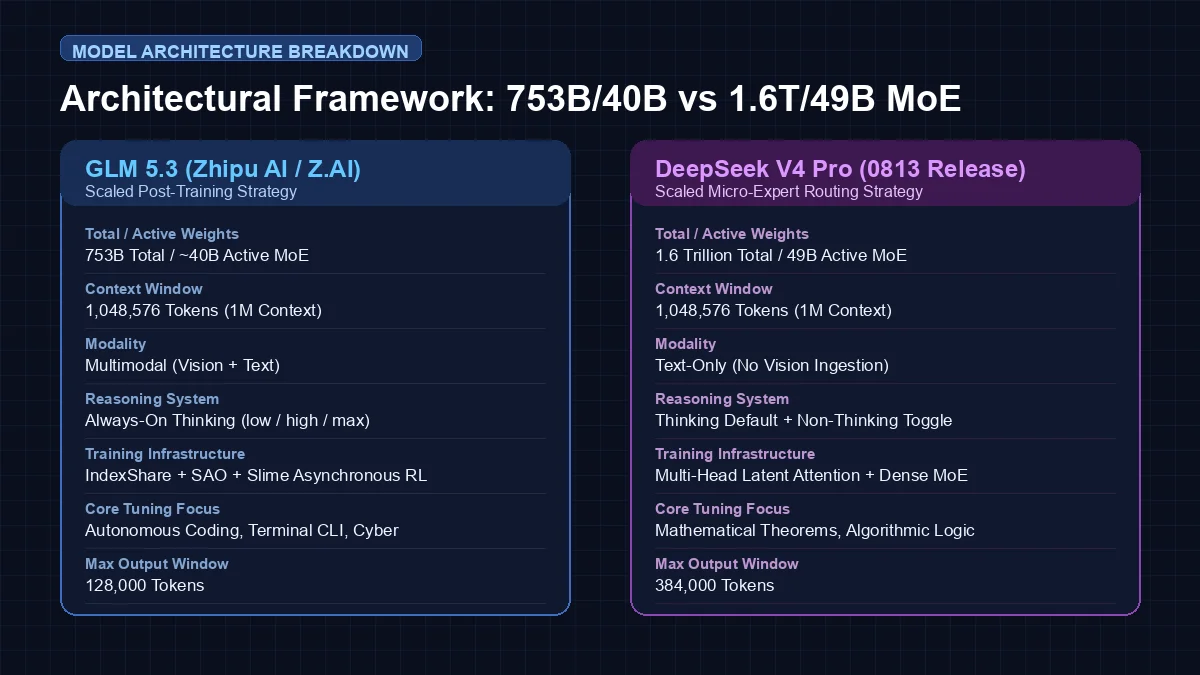
The most persistent misconception surrounding GLM 5.3 vs DeepSeek V4 Pro stems from headline parameter counts. Superficial commentary frequently frames DeepSeek's 1.6T model as twice the scale of GLM 5.3's 753B architecture. When examining inference costs and operational execution, that comparison breaks down.
DeepSeek V4 Pro: The 1.6T Micro-Expert Cluster
DeepSeek V4 Pro employs an extreme Mixture-of-Experts layout featuring 1,600 billion total parameters distributed across hundreds of granular routing pathways. During any given forward token pass, the routing network activates exactly 49B parameters.
Think of DeepSeek V4 Pro as a massive corporate consultancy employing 1,600 specialists. When a client poses a complex query, a central dispatcher assembles an ad-hoc task force of 49 domain specialists to produce the answer. You benefit from the vast, static breadth of a 1,600-person enterprise, but your computational invoice only reflects the work done by the 49 active consultants. This high parameter-to-active ratio explains why DeepSeek can operate at low inference costs despite colossal total weight volume.
GLM 5.3: Post-Training Maximization on Proven Weights
In stark contrast, Z.AI made the deliberate engineering decision not to train a new base model for GLM 5.3. The model retains the foundational 753B/40B MoE weights established by GLM 5.2. Instead, Z.AI invested all subsequent engineering cycles and compute budgets into scaling post-training reinforcement learning:
- IndexShare: A proprietary infrastructure protocol optimizing memory bandwidth across massive million-token context windows.
- SAO (Systematic Agent Optimization): An algorithmic framework specifically designed to train long-horizon multi-step trajectory stability without drifting.
- Slime: An asynchronous RL training system that enabled reinforcement learning across thousands of diverse coding environments and terminal execution sandboxes simultaneously.
Returning to our analogy: while DeepSeek expanded the roster of its consulting firm, Z.AI kept the same 753-person organization, took their top 40-person elite technical team, and put them through months of rigorous, isolated simulations in software engineering, terminal tool usage, and cybersecurity incident response.
The practical takeaway for developers: DeepSeek V4 Pro offers broader parametric general knowledge and superior raw mathematical theorem deduction, while GLM 5.3 behaves like a hyper-specialized senior software engineer trained specifically for CLI tooling and coding agents.
Coding and Agent Benchmarks: Where the Rubber Meets the Road
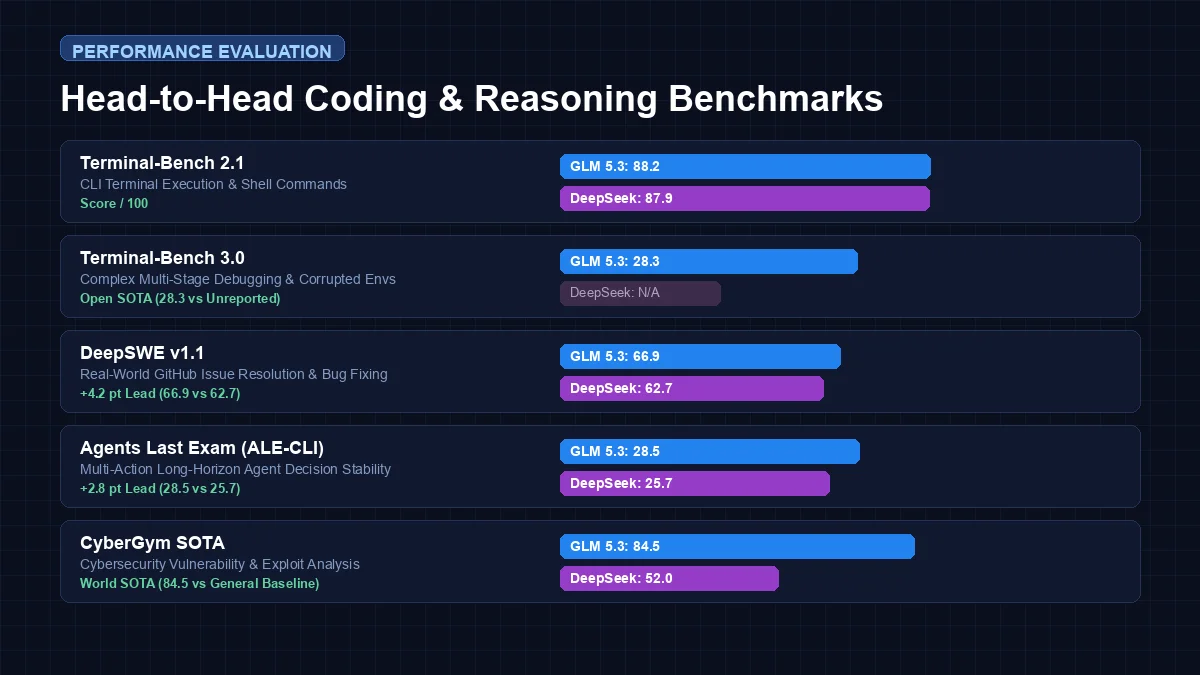
When evaluating GLM 5.3 vs DeepSeek V4 Pro for developer tooling, generic academic benchmarks like MMLU are largely uninformative. Production value is decided on rigorous execution harnesses such as Terminal-Bench, DeepSWE, and agentic multi-action environments.
Here is how the two models compare across verified standardized benchmarks in this head-to-head GLM 5.3 vs DeepSeek V4 Pro evaluation:
Terminal-Bench 2.1:
  GLM 5.3:          88.2  █████████████████████████
  DeepSeek V4 Pro:  87.9  ████████████████████████░

Terminal-Bench 3.0:
  GLM 5.3:          28.3  ████████████████
  DeepSeek V4 Pro:  --    (Not benchmarked / No public score)

DeepSWE v1.1:
  GLM 5.3:          66.9  █████████████████████
  DeepSeek V4 Pro:  62.7  ███████████████████░

Agents' Last Exam (ALE-CLI):
  GLM 5.3:          28.5  ██████████████████
  DeepSeek V4 Pro:  25.7  ████████████████░░
1. Terminal-Bench 2.1 and 3.0 (CLI Tool Mastery)
On Terminal-Bench 2.1, both models trade blows near parity: GLM 5.3 posts 88.2, while DeepSeek V4 Pro reaches 87.9. Both models excel at straightforward terminal commands, directory traversal, git manipulations, and single-file modifications.
The critical separation emerges on Terminal-Bench 3.0, a drastically harder benchmark introducing corrupted environments, ambiguous shell errors, multi-stage compilation failures, and incomplete documentation. GLM 5.2 previously scored a baseline 4.6 on this suite. Through Z.AI's post-training push, GLM 5.3 surged to 28.3, establishing open-weights state-of-the-art and matching frontier closed offerings (such as GPT-5.6 Sol at 34.6 and Claude Opus 4.8 at 21.1). DeepSeek has not published a Terminal-Bench 3.0 score for V4 Pro.
2. DeepSWE v1.1 (Repository-Level Issue Resolution)
On DeepSWE v1.1 (a benchmark evaluating an agent's ability to locate, diagnose, fix, and verify tests for realistic GitHub repository bugs), GLM 5.3 scores 66.9, pulling ahead of DeepSeek V4 Pro's 62.7 by 4.2 points.
This difference reveals itself in autonomous coding harnesses like OpenCode or Cline. While DeepSeek V4 Pro frequently constructs mathematically elegant algorithmic patches, it is more prone to forgetting surrounding project conventions or failing to run repo-specific integration tests. GLM 5.3's reinforcement learning heavily prioritized end-to-end task closure, leading to fewer abandoned agent loops.
3. Emergent Cybersecurity Capabilities
An unexpected consequence of GLM 5.3's aggressive post-training was the emergence of advanced cybersecurity reasoning. On CyberGym, GLM 5.3 achieved a world-class score of 84.5, surpassing dedicated security models. On ExploitBench, it scored 54.4, more than doubling GLM 5.2's 24.4.
If your workload involves vulnerability static analysis, penetration testing automation, or security audit logs, GLM 5.3 possesses specialized capabilities that DeepSeek V4 Pro's generalized reasoning pre-training does not match.
💡 Try GLM 5.3 in Your Browser or IDE
Want to benchmark GLM 5.3 on your hardest code bases without committing to complex infrastructure? You can test GLM 5.3 live on GLM5 in your browser with zero setup, or connect your favorite IDE tools (Cursor, VS Code, OpenCode) directly using our OpenAI-compatible endpoint at
https://glm5.app/api/v1.👉 Start Testing GLM 5.3 on GLM5 · Explore API Documentation · View Pricing Plans
Pricing and Economics: Fresh Tokens vs Prompt Caching
In any practical GLM 5.3 vs DeepSeek V4 Pro pricing analysis, frontier model bills are rarely dictated by advertised base prices alone; real costs depend heavily on prompt-caching hit ratios and output token volume.
Official API Token Rates
| Token Bucket | GLM 5.3 Rate | DeepSeek V4 Pro Rate | Cost Delta |
|---|---|---|---|
| Fresh Uncached Input | $1.40 / 1M tokens | $0.435 / 1M tokens | DeepSeek is ~69% cheaper |
| Cached Input (Cache Hit) | $0.26 / 1M tokens | $0.003625 / 1M tokens | DeepSeek is ~98.6% cheaper |
| Output Generation | $4.40 / 1M tokens | $0.87 / 1M tokens | DeepSeek is ~80% cheaper |
At first glance, DeepSeek V4 Pro appears overwhelmingly more affordable across every single line item. However, calculating true production expenditures requires examining the execution profile of each model.
Real-World Cost Analysis: The Agentic Coding Loop
To understand the real-world financial trade-offs in this GLM 5.3 vs DeepSeek V4 Pro breakdown, consider a realistic agentic coding workflow:
- Initial prompt + codebase context: 150,000 tokens.
- Agent loop length: 20 iterative turns.
- Each turn generates: 2,000 output tokens (including thinking tokens and shell instructions).
- Caching policy: Turn 1 incurs a 100% fresh input cost; Turns 2 through 20 achieve an 85% cache hit rate on repeated repository context.
DeepSeek V4 Pro Calculation:
- Turn 1 Input: 0.15M × $0.435 = $0.06525
- Turns 2-20 Inputs (19 turns):
    Cached portion (85% = 127.5K tokens × 19 = 2.4225M tokens): 2.4225 × $0.003625 = $0.00878
    Fresh portion (15% = 22.5K tokens × 19 = 0.4275M tokens): 0.4275 × $0.435 = $0.18596
- Total Output Tokens (40,000 tokens): 0.04M × $0.87 = $0.0348
Total Loop Cost on DeepSeek V4 Pro: ~$0.295

GLM 5.3 Calculation (API Pay-As-You-Go):
- Turn 1 Input: 0.15M × $1.40 = $0.210
- Turns 2-20 Inputs (19 turns):
    Cached portion (2.4225M tokens): 2.4225 × $0.26 = $0.62985
    Fresh portion (0.4275M tokens): 0.4275 × $1.40 = $0.5985
- Total Output Tokens (40,000 tokens): 0.04M × $4.40 = $0.176
Total Loop Cost on GLM 5.3 (API): ~$1.614
The Coding Plan Alternative
While DeepSeek V4 Pro wins hands-down on per-token metered API pricing ($0.295 vs $1.614 per 20-turn session), Z.AI bridges this gap through its dedicated GLM Coding Plan:
- Coding Plan Lite: $18/month ($12.60/month billed annually) providing 2,000 five-hour and 10,000 weekly credits.
- Coding Plan Pro: $80/month ($56/month billed annually) providing 12,000 five-hour and 60,000 weekly credits.
For individual engineers and active software development teams using IDE plugins (such as Cursor, VS Code Continue, or OpenCode) for 8 hours daily, flat-rate subscription credits often prove far more predictable and cost-effective than uncapped per-token API invoicing.
Modality and Operational Boundaries
Beyond benchmarks and price sheets, the GLM 5.3 vs DeepSeek V4 Pro comparison reveals several non-negotiable operational boundaries that separate these two flagships. Overlooking these architectural differences during system design can force costly mid-project rewrites.
1. Vision and Multimodal Ingestion
- GLM 5.3 is natively Multimodal: It accepts both high-resolution imagery and text. In real development workflows, you can pass UI screenshots, Figma component exports, architectural sequence diagrams, or PDF design specs directly to GLM 5.3 to generate frontend code.
- DeepSeek V4 Pro is strictly Text-Only: DeepSeek's 0813 flagship model does not accept images, video frames, or audio inputs. If your engineering pipeline involves multimodal QA, visual regression debugging, or diagram parsing, DeepSeek V4 Pro cannot be deployed without a separate multimodal pre-processing vision model.
2. Thinking Mode Mechanics and Latency
- GLM 5.3 has Thinking Permanently Enabled: Following the GLM 5.3 upgrade, thinking cannot be toggled off (
thinking.type: "enabled"is mandatory). You can modulate reasoning depth viareasoning_effort(low,high,max), but the model will always emit internal deliberation tokens before generating user-facing output. - DeepSeek V4 Pro Supports Dual Modes: While V4 Pro defaults to thinking mode, it provides an official API toggle to disable thinking entirely. This flexibility allows developers to utilize V4 Pro's massive 1.6T knowledge base for high-throughput, low-latency tasks (like rapid entity extraction or bulk classification) without waiting for extended deliberation phases.
3. Maximum Output Windows and Concurrency Quotas
- Output Length: DeepSeek V4 Pro supports an extraordinary maximum generation limit of 384,000 tokens, compared to GLM 5.3's 128,000 tokens. For synthesis tasks requiring the generation of entire novel chapters, massive database migration scripts, or monolithic multi-file dumps in a single response, DeepSeek V4 Pro provides a threefold larger output runway.
- Concurrency Guardrails: First-party access to DeepSeek V4 Pro via
api.deepseek.comenforces a strict concurrency ceiling of 500 concurrent requests to manage server farm loads. In comparison, GLM 5.3 enterprise infrastructure accommodates higher parallel stream allocations.
Decision Framework: Which Model Should You Choose?
To make the right GLM 5.3 vs DeepSeek V4 Pro decision for your engineering stack, use this structured decision rubric:
                    Do you need image / visual input?
                               /         \
                             YES          NO
                             /              \
                     Deploy GLM 5.3    Are you running an autonomous coding
                                       agent (Terminal / SWE-bench tasks)?
                                              /         \
                                            YES          NO
                                            /              \
                                   Choose GLM 5.3      Is raw inference budget /
                                   (Higher task        caching discount primary?
                                    completion rate)          /         \
                                                            YES          NO
                                                            /              \
                                                    Deploy DeepSeek    Are you using
                                                        V4 Pro         interactive IDEs?
                                                    (Unbeatable cost)     /         \
                                                                        YES          NO
                                                                        /              \
                                                                GLM Coding Plan   DeepSeek V4 Pro
                                                                (Fixed credits)   (384K output max)
Choose GLM 5.3 If:
- You build autonomous coding agents: Your system executes shell commands, runs continuous tests, and manages multi-file refactoring where Terminal-Bench 3.0 and DeepSWE stability prevent costly infinite retry loops.
- Visual context is required: Your workflows involve reviewing UI mockups, interpreting performance flame graphs, or analyzing architectural diagrams alongside source code.
- You prefer predictable developer subscription spending: Your engineers spend all day in IDE tools where the fixed credit tiers of the GLM Coding Plan eliminate token anxiety.
- Your focus is cybersecurity and vulnerability remediation: You require specialized capabilities backed by CyberGym SOTA scores.
Choose DeepSeek V4 Pro If:
- Raw API token cost is your governing metric: You process hundreds of millions of tokens weekly and can leverage KV cache hit rates of 80%+ to achieve unmatched $0.0036/M input economics.
- Your problems are heavy math and formal algorithmic logic: You require deep, deliberate chain-of-thought mathematical derivations where DeepSeek's expert cluster excels.
- You need toggleable thinking modes: You want a single flagship model that can switch between deep reasoning for difficult tasks and rapid, direct generation for simple workflows.
- Massive output size is mandatory: You generate monolithic codebases, long synthetic datasets, or extensive technical documentation that exceed 128K tokens per response.
In summary, the GLM 5.3 vs DeepSeek V4 Pro choice comes down to whether your primary constraint is autonomous coding completion and multimodal workflows (where GLM 5.3 leads) or ultra-low token economics and massive pure-text generation (where DeepSeek V4 Pro excels).
Ready to Upgrade Your AI Stack? Deploy GLM 5.3 on GLM5
Whether you are evaluating GLM 5.3 vs DeepSeek V4 Pro for autonomous coding agents, calculating prompt caching savings, or benchmarking reasoning throughput, you don't have to navigate confusing multi-vendor billing or complex infrastructure setups.
GLM5 (glm5.app) unifies the entire frontier model ecosystem into a single seamless experience:
- Instant Browser Access: Chat with GLM 5.3 immediately in our playground at glm5.app/chat with full multimodal vision support.
- OpenAI-Compatible Public API: Connect any IDE (Cursor, VS Code, OpenCode) or backend agent with drop-in compatibility at
https://glm5.app/api/v1. - Unified Credit System: Fund your web chats and API agent loops from one shared, transparent credit pool—no recurring enterprise lock-in or separate contracts.
import os
from openai import OpenAI

client = OpenAI(
    api_key=os.environ.get("GLM5_API_KEY"),
    base_url="https://glm5.app/api/v1",
)

response = client.chat.completions.create(
    model="glm-5.3",
    messages=[
        {
            "role": "user",
            "content": "Diagnose the deadlock condition in this async worker loop and write a regression test.",
        }
    ],
    extra_body={
        "thinking": {"type": "enabled"},
        "reasoning_effort": "high",
    },
)

print(response.choices[0].message.content)
🚀 Start Using GLM 5.3 on GLM5 Today · Read the Full API Docs · Compare Pricing & Credit Tiers
Sources
- DeepSeek Official API Documentation — Authoritative endpoint specifications, 0813 release parameters, context limits, and token pricing schedules.
- Artificial Analysis LLM Benchmark Index — Independent third-party evaluations of DeepSeek V4 Pro 0813 intelligence index, token throughput, and latency metrics.
- HuggingFace THUDM GLM Repository — Open-weights repository, model card disclosures, and MIT open-source licensing details.